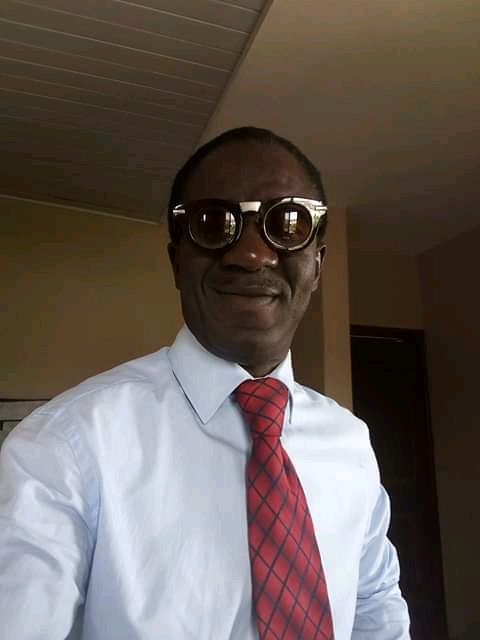
Solomon Aboagye

Spotlight

Introducing Solomon Aboagye …..


Can you tell us a bit about your journey since 1980 (or is it 1982?)

I did return to do 6 th form, so I remained till 1982. I actually served as Catholic Chapel prefect, and also assisted Kwegyir Safo-Adu in his duties as Dining Hall prefect. I subsequently proceeded to UST that year and became a card-carrying Katangese. That should have lasted for three years, but thanks to the Rawlings aluta of 1983, we sat out a year and I completed in 1986.

After my national service at VRA, I went to Scandinavia (Bergen, Norway to be precise). The intent was to get a graduate degree in Information & Computer Science at the University of Bergen. After several memorable years in that beautiful land and a completed coursework, I decided to change track and pursue an MBA, which took me to Texas for the next two years. Next stop after that program was Gaithersburg, Maryland in the Washington DC area, where I actually settled down for the next couple of decades.

Within the last five years I have pulled up roots again and relocated to Highland, California which is about 70 miles east of Los Angeles. I think my nearest GC neighbor is Felix Laryea, who lives about 20 minutes west of me.


Looks like you’ve been around a few interesting places! Which of these places did you like the most?

Each of them had their own charm, and I enjoyed them all while I lived there. Norway is one of the most naturally beautiful places on the planet. Majestic fjords, rugged mountains, clean quaint towns, etc.

Texas has its wide open spaces, friendly southern folks, great barbeques, and the Baylor University campus was a wonderful place to study. As mentioned, I settled in the DC area for most of my time here to date, and I loved the vibrant diversity of people there, and all the hustle and bustle and signs and symbols of the nation’s capital city.

Now I live in a small town Highland, which is nestled at the foot of the beautiful San Bernardino mountain range, and I like the quiet, laid back nature of this place.


What does your career look like?

I am a Software Localization Engineer and Localization Project Manager. Yes, that’s a bit of a mouthful, and I can think of perhaps only one GC, Martha Asmah, who may know what that is. The Localization industry was a small, niche market until the advent of the internet, and has now exploded in growth. In short, it is adapting products (usually software, websites, marketing items, packaging, etc) for use in various languages and cultures.

The heart of the Localization process is therefore the translation of materials from one language to another. So for example, when you open your software program, you might see something like this:

However, if the company that makes this software wanted to sell it to Russia, the Russians would want to see this in their own language, and so the program would have to be localized into Russian as follows:
Similarly, the Chinese would only buy the software if they can have it localized as follows:

In a nutshell, my job as an Engineer is to extract all the translatable materials from the software, and then as a Project Manager, to procure the services of professional translators and reviewers to do the translation work. Once these are returned, I wear the Engineer hat again to ensure that the translations are properly built back into the software and tested to assure that it performs identically as the original.

I currently work at Esri located in Redlands, California, the company that makes the above Geographic Information Systems (GIS) software. We currently support up to 37 languages.


What about family life and leisure time?
I met my wife in Bergen, Norway while she was also an international student from Lagos. One more reason to like Norway, I guess. We were married in Maryland in the early 90s, and have two boys and a girl, all currently in various stages of college and graduate school.

We enjoy travelling a lot, and did a fair amount of that around the US while the children were younger. I also very much enjoy playing the bass guitar. You’ll probably remember my pop-chain days in the Friction band with Michel Amuah, Victor Avudzivi, Sammy Yeboah, Sarbeng, Awuku-Darko, Mike Chothia, etc. These days I play the bass once a month for my church. You can catch me live one Sunday when I’m scheduled to play (www.trinityonline.org). I think for the rest of the year I’m on for 24/11 and 15/12.


The Sep 2020 Re-union is just under a year away, is there a chance we might relive the good ole days and see the Friction Band reforming to perform a one of concert during the Reunion?

I would love to, but realistically, it would be quite an undertaking to get all those “grey old men” adequately prepped for something like that. Besides we’ll be missing some key members like our vocalist and lead guitarist. Hence the reunion will probably have to make do with good old jamming with records!


You were instrumental in forming OAA 80 North America. Can you tell us a bit about that?

Sometime in the early to mid-2000s, Kwamina Hudson, Kofi Darfoor and I talked about how we could form an identifiable body of OAA 80 folks domiciled in North America (including Canada, the US and Mexico). Unlike those in Europe, where distances are considerably shorter and people are able to meet and bond more frequently, we knew that ours would need a different approach, as our mates were scattered all over this vast geographical area called North America. We decided to forge ahead as a primarily on-line community (at that time without the benefit of WhatsApp).

So we contacted as many people as we could find, drafted operational guidelines which became the basis of our Articles of Incorporation and then formed a 501(c)3 non-profit entity called ‘The Old Achimotan Association 1980 Year Group of North America’. We then elected officials and started work building the group. Over the years we had several quite successful fundraisers with 70-80% participation rates (all by email and phone!) and collaborated with OAA Ghana on a number of projects such as the headmistress’s office furniture, chemistry lab refurbishment, best house cup, sponsoring one or two Founders Day events, etc.


Any thoughts for GC?

Well, even this website is testimony to the progress we have made as a group. I think we have come a long way and achieved much good, kudos to each and every member of OAA 80. Let’s continue the good work. I’d also like to say that, while we rightly ought to cherish our relationships, meet-ups, get togethers, support for each other, etc, we should also remember that what made all this possible is our common association with that dear place called Achimota School.

Let us strive therefore to do our best not to be left out of our common efforts to help her, so that we may leave a lasting legacy in the school for future generations.

Solomon Aboagye
1C, 2B, 3A, 4S1, 5S1, L6E, U6E
Lugard House

Doreen Scott

Spotlight

Introducing Doreen Scott….


Can you give us a brief synopsis of your career history? 

I have been teaching in the Boston Public Schools’ system since 1994. Prior to teaching, I dabbled in many things. I worked as an office secretary for a church, an administrative assistant for a Dean’s office at a college, and a box office manager for a local family theater. I have also been a part owner of a dry cleaning business.


Your career has certainly been varied, but what motivated you to become a teacher?

I have always wanted to teach. I remember (I think I may have been in Class Two at Ridge Church School then) sitting under a large tree in our yard pretending to be a teacher to my dolls and younger brothers, if I could get them to sit still for a moment. For some reason, wielding some chalk and a pointer always held some fascination for me as I was growing up.

I was actually hoping to return to Ghana to teach at Ridge Church. After I got married however, that plan didn’t work out. I was working in the Dean’s Office when my best friend encouraged me to go for my Masters in Education so I could teach here in Boston. At first, I balked at the idea because I’d heard that American children were a handful and quite disrespectful. I told her “No thanks!”, but she is quite persistent, and she convinced me that I would be a good fit for public school children. Twenty five years later, I am still enjoying what I do. No day is ever the same.


Do you recall a specific teacher(s) who made an impact on your life?

Mrs. Robinson (I’m hoping I’m remembering her name correctly) was one of my teachers at Ridge Church School. The way she read books to us made them come alive in my vivid imagination, and I was determined that I would do the same when I became a teacher.  Mrs. Abbam, who was another one of my teachers, influenced and deepened my resolve to become a teacher. I adored Mrs. Andrews and Mrs. Oddoye and wanted to be like them.

My mother-in-law Mrs Abbam, named above as one of the specific teachers who made an impact on your life, and taught a few of our GC colleagues in Ridge Church school, says people are “called” to be teachers, do you agree with that statement?

I have also heard of the saying “those who can’t, teach”. In my years of teaching, I have seen examples of both. There are teachers who come to class to do the barest minimum. They are armed with coffee and a newspaper or other reading material. Upon arriving to class, they hand out sheet work to the students, then put their feet up on the desk or get comfortable, and ignore the class. Maybe, those belong to the “those who can’t, teach” group.

Those who are truly called are passionate about this calling. They are very reflective about their craft. They know that they have the lives of impressionable young people in their hands for ten or so months, and know that what they teach or how they engage their students today will affect the lives and future of the young people in their charge. That making a difference in the lives of children is worth every effort. They take this calling very seriously.


What has been your most rewarding experience in the classroom?

Every year, the Lord graces me with students who teach me about myself and about teaching. My students have taught me the value of patience. Every child doesn’t mature at the same rate as his/her peers. I have had the pleasure of working with students who are new to the country, with no knowledge of conversational English, blossom into non-stop chatterers once English is acquired.

I have worked with students who have been reluctant readers and writers, who’ve grown to become lovers of literature. I have nurtured struggling math-phobians into Math awardees by the end of the year. Seeing these transformations between September and June, give me great pleasure and immense joy.


What has been your most challenging experience and how did you overcome it?

Some years, my challenge is with particular students. Other years, it is with some parents. This year, I have both. I have a student who is struggling to focus in class. He is unable to rein in his body or thoughts or mouth. He is constantly on the go – whether he’s fidgeting, humming, or talking to himself, he can’t seem to calm himself down. He tends to distract his peers quite a bit. He will leave his seat the moment my back is turned and head towards someone to engage with. Students have complained that he uses inappropriate language and gestures. Many are not comfortable with him because he tends to put his hands on them.

The parent asked, about three weeks ago during our Open House, that I keep her updated on his behavior in class. I reached out yesterday because it had been one thing after another in terms of his behavior. I was hoping to have another meeting with her – any support to help this young one become more productive. She got quite angry with me for blaming all the issues/problems on her son, claiming that he says he’s being bullied.

This is not the first time this has happened though, in all my twenty five years (this October) of teaching, so I’m not worried. I’m not the only teacher in the building who has seen him in action, so technically, she has no leg to stand on. However, I now know the kind of support/s (or lack thereof) that I can receive from her so I can plan accordingly.


Are you involved in any charitable/ mentoring activities etc?

During the week, I am in a sense, mentoring my twenty three young charges. I am also keeping tabs on a few young teenagers in the middle-school, checking in to make sure that if they are having some emotional difficulties, I can be of some help, even if as a sounding board. Many of our students come from homes that have experienced some form of trauma, and for many of them, they consequently have socio-emotional challenges.

Most Saturday mornings, you will find me tutoring a sixteen year old young man who is autistic and on Sunday, I am involved in church as a worship leader.


During our time in Motown, you were cast as one of the lead characters (Yum Yum) in Gilbert and Sullivan’s MIKADO. Have you continued in the performing arts?

Yes. During the period that I was working at the local theater, I performed in their production of the Sound of Music, as well as bit parts in other productions. I was at that time also pursuing my Masters degree, so it was difficult to juggle both. I work with our church’s performing arts group (Symphoneo) to put on performances for Easter, for the church’s anniversary, and for Christmas. On occasion, I perform in other drama skits. I also write and perform spoken word pieces.

Outside of work, what do you do for relaxation?

I spend a lot of time with family in my free time. I delight in going away with my husband for weekends to bed and breakfasts or hotels near the ocean. I also spend time with my niece and look forward to playing with her two adorable children who are under the age of two. I enjoy watching NFL (National Football League) games, reading, or sudoku-ing (or other puzzles). I relish watching the Cooking Channel, even though I’d rather eat than cook!

How will you be celebrating the upcoming Thanksgiving holiday?

This Thanksgiving, by God’s grace, I will be in Accra. I’m looking forward to spending some quiet time with my mother, who has been diagnosed with dementia. It is always a blessing to be in her presence and to enjoy her bubbly personality. Being so far away from her is difficult, so having this opportunity is really special.

Although on the other hand, I will be away from my husband and son, thanks to technology, we will have many opportunities to remain connected. Last year, we enjoyed a Ghanaian Thanksgiving with jollof rice, groundnut soup and fufu, and salmon and kenkey (with pepper) – among other dishes. My nephew requested my chicken alfredo dish, so that was also on hand. This year in my absence, they will probably go to my mother-in-law’s for a “regular” Thanksgiving.


Doreen Scott (nee Evans-Lutterodt)

Clark House

Look out for our next Spotlight Edition on Solomon Aboagye

Katherine Tufuoh

Spotlight

Introducing Katherine Tufuoh….

Can you give us a brief synopsis of your career history?
After returning to Ghana from the then Soviet Union, where I studied medicine, I worked at the Korle Bu Teaching Hospital for almost six years, three of which were at the National Cardio Thoracic Center, before leaving for the U.S. I studied for a master’s in public health here in the U.S. and currently work for the State of California’s Department of Public Health on injury surveillance and prevention where my main focus is on the severity of traumatic injuries and their medical outcomes.

You spent some time in Russia during your tertiary education. How was the experience and were there any difficulties in learning the language and adapting to the culture?
Yes, I lived in Russia for eight years, the first year was for learning the language and medical terminology in Russian, six years in medical school itself and then I did an internship for a year. The experience was indeed something else! Now, where do I start? It was indeed different, but I wouldn’t trade that experience for anything. I think it made me a better person being exposed to so many different cultures and learning to live and interact with different people.

My university had students from as many as one hundred and eight different countries at the time so you can imagine how that impacted my life! I met people from so many different countries, learnt a lot about their different cultures, and tried all kinds of cuisines and also learned bits and pieces of so many different languages.

The Russian language came naturally to me and I didn’t have much difficulty learning it and still speak Russian up to this day. I went the extra mile and got myself a translator’s diploma and a teacher’s certificate in Russian. I still keep in touch with my Russian roommate and have a few Russian friends out here. I believe in fully immersing one’s self in the culture of the people where you live. I had roommates from Russia and the Ukraine among others and classmates from some of the other Soviet Union Republics and learned their different ways and learned to love their different palettes. There were some dishes I kept far away from, especially the raw stuff, but all in all, it was an awesome experience!

You kindly hosted the first official Social get together for a fledgling GC at your residence in Nov 1996. After twenty-three years, would you say GC has achieved its original aim?
Wow! It feels just like yesterday! Twenty-three years already! Our aim was to keep in touch and support each other as best as we could. And yes, I think we have actually exceeded our original aim, especially through the help of WhatsApp. Look how successful the 2015 GC reunion was?

We built on that by having mini reunions here in the U.S. Barbara Mensah, Smart (Clarence Sarkodee-Adoo) and Kwame Agyare hosted us in Arizona three years ago, Angie Owusu hosted us in Florida earlier on this year and we plan our next stop to be in good old California and I am really looking forward to that.

Is there anything else you’ll like GC to accomplish over the next five years?
Most of you know that I lost my brother almost twenty-one years ago. He was only thirty-nin years old – I think life is too short and we mustn’t waste time hoping for things to change tomorrow – tomorrow never comes. I think we should live each day as if it were our last, be more tolerant of each other, keep the conversation going and have fun with ourselves. I tell you when we met for our reunions in Arizona and Florida, it was like we were kids all over again – the teasing and laughter was unbelievable, reminiscing the good, the bad and the not so good.

We are one big family and it will be great to deepen our friendship, visit each other as often as we can and keep having reunions whenever we can. Believe it or not! Sixty is on the horizon, then seventy – I didn’t think we’d get here so soon, we were kids just the other day! I hope to be able to make the twenty-three hour journey to Ghana for our reunion next year, I am really looking forward to it.

 Are you involved in any charitable/mentoring activities?
Yes, I am, I believe in giving back to society because one cannot do it all alone, we are all helped along the way and one must give back too. I have been a member of Toastmasters International for the past twelve years and I mentor new members in my club on the art of public speaking, speaking off the cuff and giving speeches without the use of notes. As part of this mentoring program, I frequently evaluate speeches and give members feedback to help them improve their speaking skills and art of giving speeches and accepting critique positively.

You’ve lived in the U.S. for the past twenty years, what would you say is your favourite city over there and why?
Yes, I have, and it’s been almost twenty-one years now! By far, I love the islands of Hawaii and the city of Honolulu’s Waikiki beach in particular. Why? Because it reminds me of Ghana – the weather, fruits, vegetables, etc. and the atmosphere out there on a whole.

Outside of work, what do you do for relaxation?
Relaxation, that’s relative, but I still love to watch movies, travel when I can and keep up with news on the waves of WhatsApp on the good old GC platforms. I also love hanging out with my boys (my two sons and the hubby), especially over the weekends, and catching up with all their escapades.

Finally, Mr. Papin had a big influence on most of your GC colleagues during their time in Motown. How did it feel meeting him recently?
Mr. Papin, Mr. Papin! He really did have a big influence on me even though I remember giving him such a hard time during class. What a pleasure it was for me to talk to him a couple of times on the phone after so many years and meet him in person for lunch with Angie Sagoe and Kwame Agyare. I reminded him of the lessons he taught us on simultaneous linear equations and he laughed so heartily. We even talked about the rumour that went around back in the day that he worked for the CIA. He said he remembered that too and just played along with that notion.

Katherine Tufuoh
1C, 2B, 3D, 4S2, 5S2
Kingsley House

Sylvester Atta-Mensah

Spotlight

Introducing Sylvester Atta-Mensah………

You were a Science Student in school and hence how did you end up a Fashion Designer as your chosen profession?

After school, I had a brief stay in the UK where I happened to work with a fashion house called Anton O, in the North of London.  It was where I developed an extreme passion to become a clothes designer bringing out my natural artistic and creative abilities. 

On my return to Ghana, I started a small fashion business utilising a space in my my mother’s provision shop at Ringway Estates at Osu in Accra.  The business picked up well because of the skillsets acquired during my brief work experience in the UK.  It was at this point that I pioneered the designing of Kente combination dresses and shirts with Kente designed Caps and Headgear, which has been the going trend in Ghana to date. This was way back in 1988 and for this, I was featured in the Weekly Spectator newspaper of 8th November 1988.  In December of the same year, I held the first designer fashion show in Kumasi on the theme Fashion Focus, at the then City Hotel.

 With these achievements, I then decided to groom myself properly as a fashion designer leading to my move from Ghana to Italy where I enrolled at the Instituto Moda Industriale in Brescia, where I did a 2-year course in six months and was the first African student and the best student of that year (1993).  I went on to specialize in Ladies wear and accessories (including lingerie and leather accessories like shoes and bags). To date, my works still hang in the show rooms of the school.


As a budding fashion designer in Italy, did your ethnicity create any setbacks and if so, how did you overcome that?

My challenge started at the end of this almost fairy tale experience, when I was kicked out of the fashion company I had just started working with. Their reason being that clients were reluctant to do business with a company with a black man in the role of fashion designer, However, brave me, I took up the challenge, with pride in my African heritage and skilled in my profession to set up my own fashion label/brand ‘ATTA KOFI’ deciding to use my African identity rather than the identity I used in school, Sylvester Atta-Mensah.

After the first few years of difficulties, ATTA KOFI has become an established brand not only in Italy, but I am also on the data base of important fashion events worldwide, for e.g. New York Fashion, CPD in Dusseldorf, Germany, READY-TO-SHOW in Milan, Italy, MAGIC SHOW in Las Vegas, U.S.A, and I.S.P.O. in Munich, Germany.

My speciality is with ‘red-carpet’ clothing for ladies.  However, at the same time, I design a jeans line called A.K.J.C (Atta Kofi Jeans Culture) and I have a Sportswear Line called AKshion (Atta Kofi Fashion).

What do you think of the Ghanaian Fashion Industry since your re-location to Ghana?

The clothing or fashion industry in Ghana is not the best and is still in its ‘agitation’ stage and I think there is a lot more work to be done to bring it to international standard levels.  There are no precise fashion schools in the country. Most of the institutions are in actual sense dressmaking schools and not fashion designing schools. But it is all good because we need to start from somewhere to get somewhere.

Furthermore, the industry is choked with novices who are just thinking about making money and not excellence in their trade. When you talk about fashion in Ghana, it is the African wear syndrome that is trending, but unfortunately trending for locals and a negligible percentage of the foreign community. On the international front, African wear is also negligible. I just think that there is more to be done in this industry.  Once my set-up in Ghana in complete, I will be at the service of all AKORAS….E VIVA !!!!!


What difference are you going to infuse into the fashion industry in Ghana to strengthen the industry as you appear to have reservations about the African Wear trend?

First, I think that I have done enough homework about setting up in Ghana, principally because I want to work from Africa or better still reach out to the world from Africa. It is a clarion call for the world to know that good things and even the best also comes from Africa.

Secondly, I’m not necessarily thinking of bringing something new into the Ghanaian fashion industry specifically but more generally my passion is to create new trends in the global fashion fraternity. However, yes, I am surely going to make a difference locally, because I am coming in with my own ideas and creativity nurtured in a top-class fashion environment. My brand(s) will again be formally out doored internationally in Accra.

My concept of operation in Ghana will be totally original from designing my own fabrics (not wax prints) and accessories to producing a ready to wear fashion line. By this concept, my clothing will be made from bespoke fabrics which will be different to generic wax prints which are sometimes used as décor at functions!  My intent is to have clothing made from fabrics (not wax print) that are also identifiable by our Ghanaian/African culture and are labelled as ‘Made in Ghana’.  

My reservations about the African wear trend are personal because of my orientation as a designer and my choice of fashion concepts. African wear must be promoted but presented under a genuine fashion ideology and not to leave control to the textile industry since their promotion is in their own interest and not that of the clothing industry as a whole, thus limiting the scope of fashion designers.


Can you share some of your most remarkable experiences with us?

One of the things that I learnt from Achimota School was that,” In anything that you do, do it to the best of your ability and it will take you before kings”.  My best lifetime experiences are the outcome of the above quote.

I met them all, Giorgio Armani, Dolce & Gabbana, Valentino, Gianfranco Ferre, Karl Lagerfeld and Gianni Versace. These were not just casual meetings but I rubbed shoulders with them at one or two events where they also exhibited where in most cases I was the only African designer.  It was a particularly emotional experience collaborating with Karl Lagerfeld in one of his casual shirts collection.  Another highlight was seeing one of my creations (as per the picture below) at New York Fashion Week.


Are you involved in any charitable/ mentoring activities you may want to share with us?

Yes, I run an international help organization called ATTA KOFI CARES.  It is currently only functioning in Sierra Leone for victims of their bloody internal war which has devastated that beautiful country of lovely people. We will become operational in Ghana once my settlement plans are concretized. Our priority will be on child care.


Finally, is there anything else you want to say to your GC colleagues and are there any upcoming events where they can turn up in their numbers to support you?

Hello to all my mates.  Schooling together in a place like ‘MOTOWN’ was a God-given experience that has brought us this far. Those who have fallen along the way are still ‘gallant’ in our minds. Motown always puts a smile on my face when I remember that I always frowned when I was given ‘corner loaf’ in the dining hall as a junior.  As for ‘soakings’, light was my favourite. What else can we be proud of, if not being Akoras.

Ciao mia Bellissima famiglia, vi invito alla miei sfilata di moda, il 26 Decembre 2019” (Hello my Beautiful Family, I invite you to my Fashion Event on 26 December 2019).  However, please kindly note that as the event is by invitation only at the Golden Tulip Hotel, you will need to contact me on 0554411570, if you’re interested in attending.

Rimango vostro compagno di scuola(I am still your Classmate).  Let us keep this fire burning. 


Sylvester Atta Mensah

1C, 2C, 3C, 4S3, 5S3

Gyamfi House


Look out for our next Spotlight Edition on Katherine Tufuoh


Nadia Simmonds

Spotlight

Introducing Nadia Simmonds….

Can you give us a brief synopsis of your career history? 
I started my career in HR a very long time ago when the function was then referred to as ‘Personnel’. My experience was mainly in the hospitality and retail sectors, where I worked for Hilton Hotels, the retail giant Tesco before settling at the iconic Art Deco Strand Palace Hotel in Central London as Head of HR where I was for over 15 years. I was very proud of my time at the Strand Palace, with the highlight having to be the great success we achieved during the 2012 London Olympics hosting various organisations linked to the Olympics and securing tickets to watch Usain Bolt in the 100 metres final was certainly the icing on the cake.

What did you do after your tenure as Head of HR at the Strand Palace Hotel ended?
I took a well-earned career break in 2017, spending a few months under-cover in Accra. It was a wonderful time allowing me the opportunity to refresh myself and reflect on what to do with my career, and whether in fact moving to Ghana was an option. I however decided to stay put in London and I have now moved to working in the construction sector for Multiplex, a global construction company which concentrates on building large scale iconic commercial and residential properties. Multiplex is on course to complete the building of 22 Bishopsgate, which at 62 floors, will be the tallest and smartest tower in the city of London.

Do you see yourself moving into other HR specialisms or related fields?
I’ve so far worked as a generalist HR professional, but I find my career moving into the specialist HR area of Diversity and Inclusion; and into other related fields such as Data Protection/Privacy (off the back of the EU’s General Data Protection Regulation which came into force last year). It’s very exciting stuff and with my love of variety, who knows what I’ll be doing in a year’s time! 

Has BREXIT had or will it have an impact on your HR role in the service/ construction industry?
One of the key issues here is labour shortages. Within both the service and construction sectors, there is a heavy reliance on both skilled and unskilled migrant labour from the EU. In the hospitality industry in particular, EU migrant labour easily makes up 50% of the workforce. The big challenge therefore if Brexit goes ahead, would be where would the supply of labour come from? Recruitment will be an issue, and additionally employers will have to up their game in looking at how to retain staff better, part of which would mean improving pay well above minimum wage levels with the knock-on effect of adding to business costs.

Investing in training and reskilling employees to take on roles previously taken up by this migrant labour will also be a focus. Furthermore, with the lack of certainty and confidence in the market, there is the adverse effect of putting a hold-on the construction of building projects. This in turn is leading to restructuring exercises and the redeployment of current employees. 

Are you involved in any charitable/ mentoring activities etc?
Over the years, I have developed a passion for the Corporate Social Responsibility and sustainability agenda and as a result have been a key driver of this focus in the businesses I have worked for. I was also involved in supporting the work of a charity (The Bruno Tampo Foundation), as a Trustee with the focus on supporting the rehabilitation of young offenders through offering them training and employment opportunities. Bruno himself, is a real success story, showing how giving someone a second chance, has the opportunity to transform lives. Bruno graduated with a 1st Class degree last year and now works in a key role for Multiplex. 

Do you have any hobbies or social interests?
Outside of work, I have a keen interest in African Art, floristry and gardening and I have always said if I had my time again, I’d be a high-flying Landscape Gardener! It has to be said my favourite place is in the garden, and I’m just like a kid in a sweet shop if I get to a garden centre! 

Finally, where is your favourite place to visit on holiday and why?
This has to be Santorini which I visited in 2017 (considered the most famous of the Greek islands) and in my view easily the most beautiful place on earth. I love the amazing picturesque scenery with characteristic whitewashed buildings and their blue domed roofs, the steeps cliffs over the Aegean Sea, sailing around the island and the breathtaking sunsets. Can’t wait to visit again! 


Nadia Simmonds
Clark House

Look out for our next Spotlight Edition on Emmanuel Arbenser.